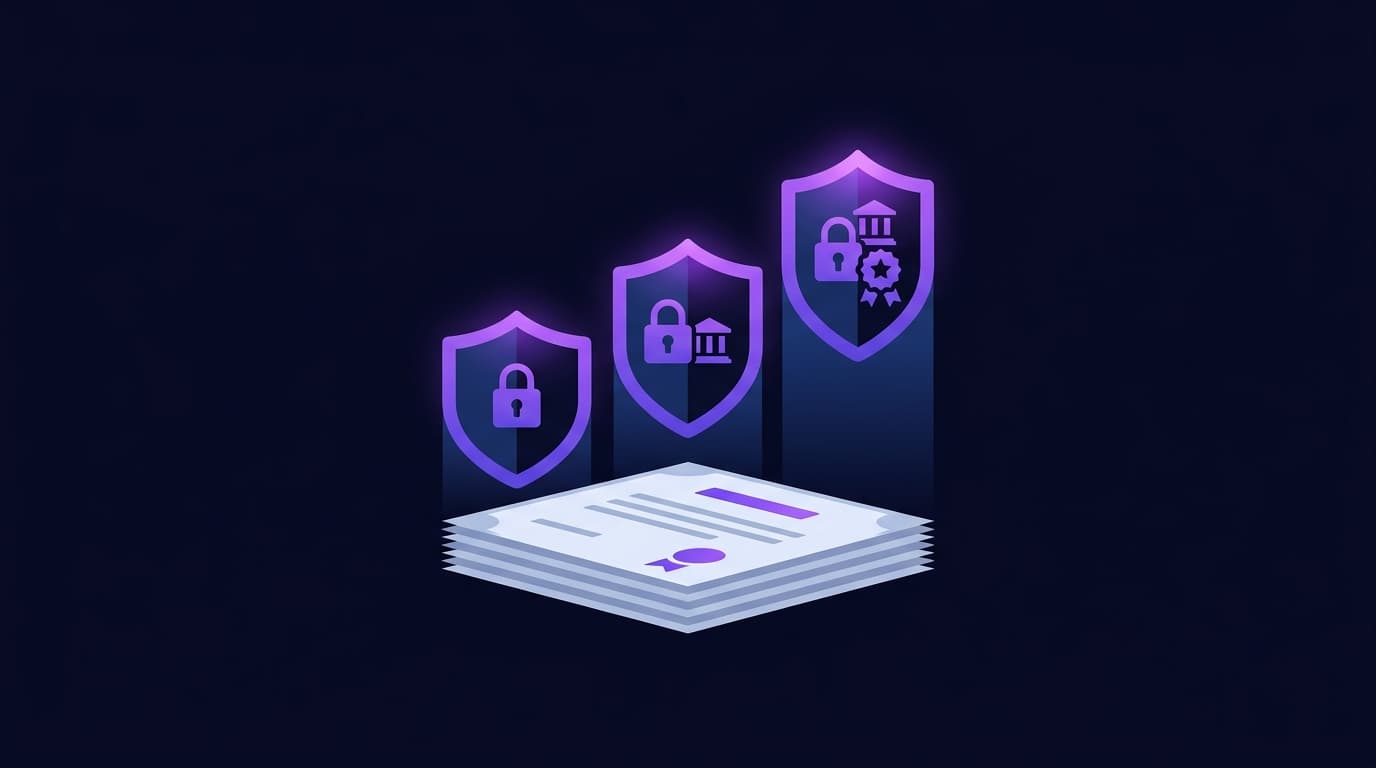
SSL Certificate Types: DV, OV, and EV — What Is the Difference?
All SSL certificates encrypt traffic with identical strength. What differs is the identity verification performed before issuance — and since 2019, the visible browser difference has largely disappeared.
What Are the Three Validation Levels?
Domain Validation (DV)
Verifies only that you control the domain name. No business information checked.
Verification: DNS TXT record, file on server, or admin email response. Fully automated. No human review. Issuance: Minutes to hours. Cost: Free via Let's Encrypt; $0–$100/year commercial CAs. Browser: Standard padlock. No organisation name visible.
DV from Let's Encrypt is cryptographically identical to paid DV certificates. The encryption, trust chain, and browser padlock are the same. For most websites, a free Let's Encrypt DV certificate is fully appropriate.
Organisation Validation (OV)
Verifies domain control plus the legal existence and identity of the organisation.
Issuance: 1–3 business days. Cost: $50–$250/year from commercial CAs. Browser: Standard padlock. Organisation details visible inside the certificate (click padlock → Certificate → Subject).
Useful for B2B contexts and regulated industries where partners check certificate details.
Extended Validation (EV)
The most thorough verification — legal identity, physical existence, operational status, authority of requester.
Issuance: Days to weeks. Cost: $100–$500+/year. Browser: Standard padlock only. Green bar with company name removed in Chrome, Firefox, and Safari in 2019.
EV certificates are now visually indistinguishable from DV in modern browsers. They remain relevant in specific regulated industries and for organisations whose internal policies require EV.
How Much Does a GoDaddy SSL Certificate Cost?
GoDaddy sells DV, OV, and EV certificates. DV certificates start around $80/year. OV runs $150–$250/year. EV runs $200–$400/year.
Comparison: Let's Encrypt issues free DV certificates that are cryptographically identical to GoDaddy's DV certificates. For DV, the free option is appropriate. The GoDaddy price premium buys support and a financial warranty.
OV and EV require business identity verification that Let's Encrypt does not provide — commercial CAs are necessary for those levels.
What Does Invalid SSL Certificate Error Code 526 Mean?
Error 526 from Cloudflare means you are running Full (strict) SSL mode but the certificate on your origin server failed validation — expired, self-signed, or issued for a different hostname. Install a valid DV certificate (Let's Encrypt) or a free Cloudflare Origin CA certificate. Our SSL error fix guide covers 526 and other common SSL errors.
ev ssl — Is Extended Validation Worth It in 2026?
For most websites: no. The green bar that made EV visually distinct to visitors was removed by all major browsers in 2019. Visitors cannot tell whether a site has a DV or EV certificate from the browser UI alone. EV is worth considering only if your security policy requires it or your regulatory environment mandates it.
Does Certificate Type Affect the Renewal Process?
DV (Let's Encrypt): Auto-renewal every 60–90 days via Certbot or hosting panel. No manual action needed when configured correctly.
OV and EV: Must repeat business verification with the CA at renewal. Commercial CAs send notices 90, 60, and 30 days before expiry. Full renewal guide: renew ssl certificate.
SSL certificates depend on the domain remaining registered. An expired domain stops SSL working — not because the certificate expired, but because DNS stops resolving and no connection can be established. Domain expiry tracking prevents this.
Quick Answers
Never lose a domain again
Track every domain you own in one dashboard. Free for up to 15 domains.