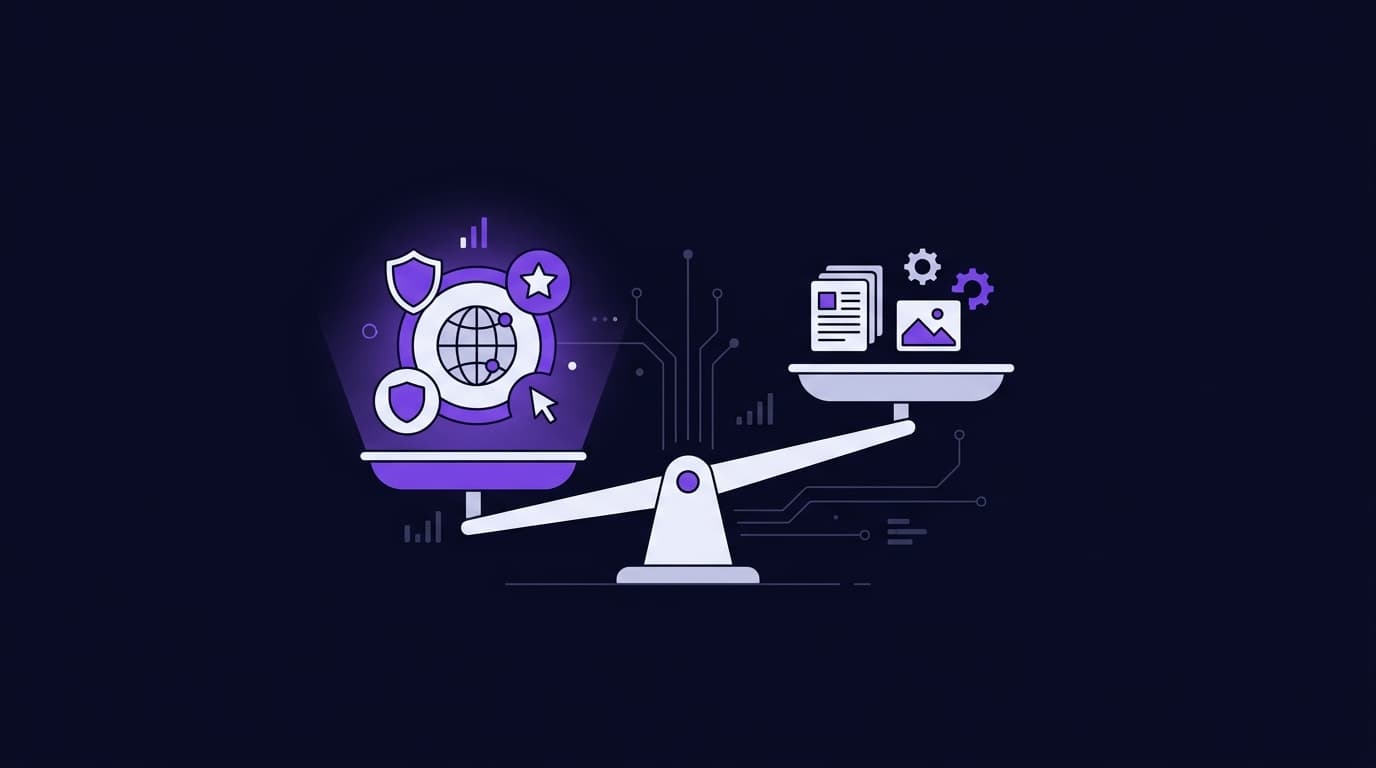
Why Your Domain Name Is Worth More Than Everything Else On Your Website Combined
If your server burned down tomorrow, you could rebuild. The website code exists in version control or backups. The content — every blog post, every product description, every page — exists in backups or can be reconstructed. Your Google ranking would drop temporarily but recover as the new site gets indexed and builds authority again. The rebuild would be painful and expensive, but it would happen. But if your domain expires and someone else registers it, that is a different story — which is why preventing domain hijacking matters so much.
Now imagine that your domain name is taken by a squatter. Not your server — just the domain name, the 15 characters before .com. What do you rebuild?
You cannot get the same domain back unless the squatter decides to sell it, which will cost you significantly more than you originally paid, if they will sell at all. The new domain — yourbusiness2.com, yourbusiness-official.com, whatever variant is available — starts with zero search engine authority. All the links pointing to the old domain are now pointing to the squatter's parked page. Every customer who bookmarked the old URL is landing somewhere you do not control. Every email that has ever included your domain in it is now sending traffic to someone else.
This is the asymmetry that most business owners do not fully grasp until it is too late: the domain name is the only truly irreplaceable digital asset a business has.
What Makes a Domain Irreplaceable?
A domain name is scarce in a way that almost no other business asset is. There is only one yourbusiness.com. Not one per region, not one per category — one, globally, forever. If someone else has it, you do not, and there is no version of obtaining a functionally equivalent substitute. You can register yourbusiness.co or yourbusiness.net, but these are not the same. Customers who type your business name and add .com out of habit will not reach you.
This scarcity compounds with time. Every year you operate under your domain, you build equity in it: search engine authority, customer familiarity, brand association, backlinks from press coverage and partner sites. This equity is stored in the domain itself. It does not transfer to a new domain automatically. Some of it can be migrated with careful 301 redirects and other technical measures, but a meaningful portion is simply lost.
Contrast this with website content. Content can be exported, backed up, migrated, and republished under a new domain. It will lose some SEO performance initially, but the content itself — the words, the images, the structure — exists independently of the domain. The domain is the address. The content is what is at the address. Addresses, once lost, are genuinely gone.
What's the Price of Domain Recovery?
When a domain squatter registers a name that belongs to an established business, they are not doing so randomly. They know the domain has value — to you. They also know that you know it has value, and they set their asking price accordingly.
Squatter pricing follows a simple logic: the domain is worth at least as much as you would lose by not having it. For a business doing $50,000 per month in online revenue, losing the domain for sixty days while a legal dispute resolves could cost $100,000. The squatter knows this. Their asking price for returning the domain is frequently $5,000 to $50,000 depending on the traffic and authority of the domain.
The legal alternative — filing a UDRP complaint to recover the domain through an arbitration process — costs $1,500 to $3,000 in filing fees alone, takes 45 to 60 days to resolve, and requires meeting a three-part legal test that is not always easy to satisfy for small businesses that have not registered trademarks.
The renewal cost of the domain was $12 to $15 per year.
What Calculation Should You Be Making?
The value of a domain to a business scales with the business. A domain for a business doing $10,000 per month in revenue is worth less to lose than a domain for a business doing $500,000 per month. But at almost any scale, the cost of losing the domain — measured in recovery costs, lost revenue, and customer trust damage — vastly exceeds the cost of maintaining it.
This calculation implies something about how seriously you should take domain security and renewal. A $15 renewal is not a $15 transaction. It is the maintenance fee on an asset that, depending on your business, could be worth $10,000 to $10 million to lose. Treating it as an afterthought, as most businesses implicitly do, is a category error.
What Does Proper Domain Management Actually Require?
Managing a domain as the irreplaceable asset it is requires three things that most businesses do not currently have in place.
The first is guaranteed renewal continuity. Auto-renewal enabled, payment method current and not subject to expiry without manual attention, renewal reminders going to an inbox that will always be monitored regardless of staff changes. Domain 360 provides the reminder layer — automatic alerts 60 days before any domain expires, sent to the email address you choose, not the one you registered with years ago.
The second is ownership clarity. The domain should be registered under a business email address, in an account that the business controls unconditionally. Not a personal email address. Not a developer's account. Not an agency account. The business should be able to access the registrar account independently of any individual or vendor relationship.
The third is security. Transfer lock enabled. Two-factor authentication on the registrar account. WHOIS privacy protection enabled. These are not difficult to implement, but they require explicitly knowing that you should implement them — which most people do not know until something goes wrong.
What's the Mental Model Shift?
The useful mental model shift is this: your domain is not a line item in your hosting budget. It is the foundation of your digital business. Everything else — the website, the email system, the Google ranking, the customer trust — sits on top of it.
A house with a cracked foundation can look perfectly fine for years. The problems show up at the worst possible moment, under the worst possible conditions, in the most expensive possible way.
Your domain renewal, your registrar account security, your renewal notification system — these are foundation maintenance. They are boring, invisible when working correctly, and catastrophic when neglected.
That is exactly the kind of thing worth paying attention to.
Never lose a domain again
Track every domain you own in one dashboard. Free for up to 15 domains.