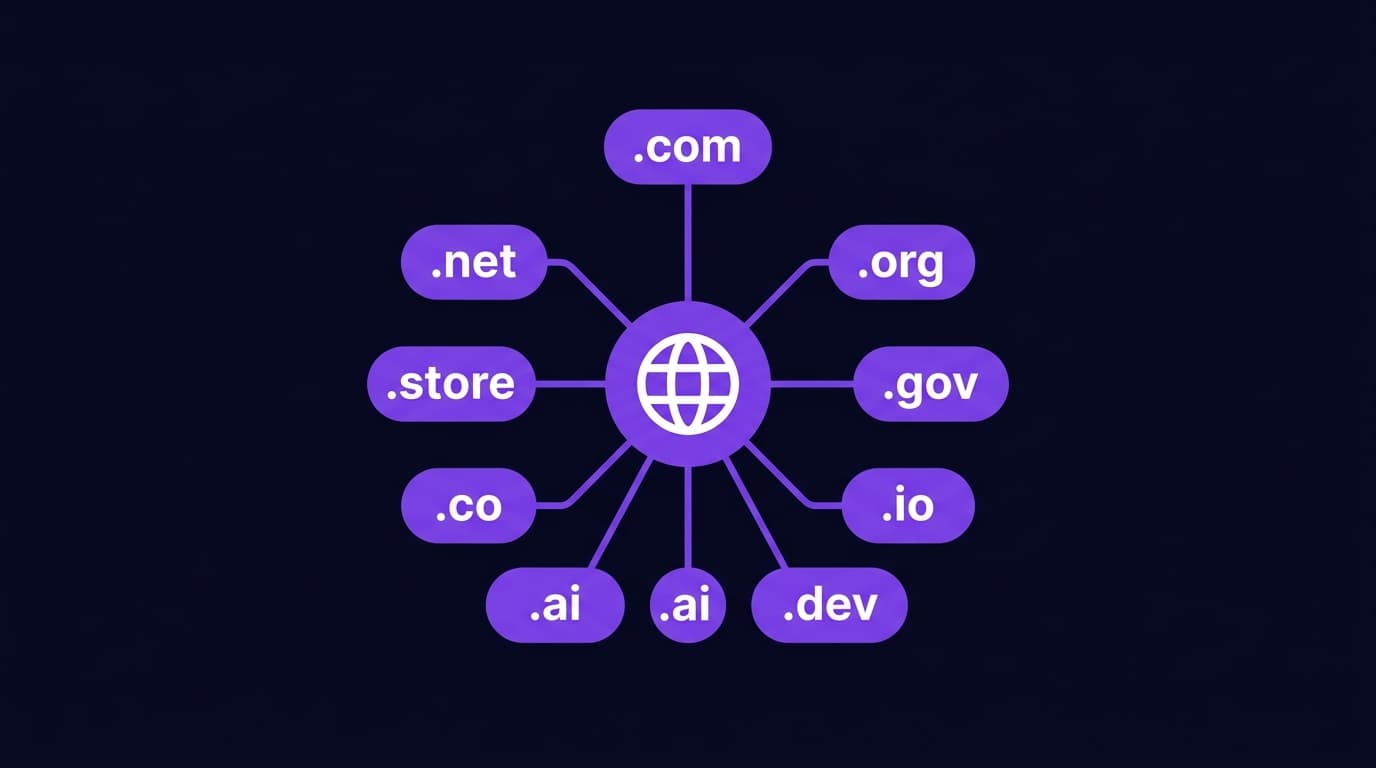
What Is a TLD? Domain Extensions Explained: .com, .org, .io, and Hundreds More
A top-level domain (TLD) is the extension at the end of a domain name — the segment after the last dot. When you type domain360.site, the TLD is .site. The choice of TLD used to be simple: .com for businesses, .org for nonprofits, .net for networks. In 2026, there are over 1,500 TLDs and the decision is more nuanced.
What Are the Three Categories?
Generic TLDs (gTLDs)
These are globally available, not tied to any country, and open to registration by anyone worldwide.
The original three: .com (commercial, launched 1985), .net (networks), .org (organizations). .com became the default for all businesses long ago regardless of category. .org is commonly used by nonprofits and open-source projects, though anyone can register it.
Restricted gTLDs: Some extensions are restricted to specific entities. .gov is only for US government entities. .edu is only for accredited US educational institutions. .mil is only for US military.
New gTLDs: ICANN opened the domain extension market in 2012, resulting in hundreds of new extensions: .site, .online, .blog, .shop, .tech, .app, .io, .co. These are all legitimate and rank equally in Google search.
Country-Code TLDs (ccTLDs)
Two-letter extensions representing specific countries: .uk (United Kingdom), .de (Germany), .ca (Canada), .au (Australia), .in (India). Country-code TLDs send a geographic relevance signal that can benefit local search rankings. Most country registries allow registration by anyone worldwide, though some have residency requirements.
Some ccTLDs have been adopted as generic alternatives: .co (Colombia) used as a .com alternative, .io (British Indian Ocean Territory) adopted by the tech industry, .me (Montenegro) used for personal sites, .tv (Tuvalu) used by video platforms.
Infrastructure TLDs
.arpa is reserved for internet infrastructure and reverse DNS. Users never register these.
What Is the .com Advantage (and Its Limits)?
.com holds several practical advantages over all alternatives:
Trust: Users default to .com. Studies show .com domains get higher click-through rates in search results because users perceive them as more established. When someone hears a domain name, they try .com first by default.
Type-in traffic: People who remember "examplebrand" but not the extension will try examplebrand.com. If you are on .io or .site, that traffic goes somewhere else — possibly to a competitor who owns examplebrand.com.
Resale value: .com domains consistently command higher prices in the secondary market than equivalent domains in other extensions. An investor holding both examplebrand.com and examplebrand.io will find the .com is worth substantially more.
These advantages are real and significant. They are also not absolute. .io has genuine brand equity in the tech startup space. .co.uk is expected for UK local businesses. .app has growing recognition for mobile software. The right choice depends on your industry and audience.
How Do TLDs Relate to Defensive Registration?
Once you choose a TLD for your primary domain, consider registering your name in additional extensions to prevent others from using them to intercept your traffic or damage your brand. The priority extensions depend on your business, but .com, .net, and your country ccTLD are the common minimum.
Our guide to protecting your brand with domain names covers the defensive registration strategy in detail.
How Do You Manage Domains Across Extensions?
When you own a name in multiple TLDs, tracking renewals becomes critical. Each extension renews at a different price on potentially different dates at potentially different registrars. An independent domain management dashboard that tracks all extensions in one view with unified expiry alerts is the practical tool that prevents any defensive registration from quietly lapsing.
Quick Answers
Never lose a domain again
Track every domain you own in one dashboard. Free for up to 15 domains.